
Pilates Studio Branding: How Reformer Design and Social Media Work Together
A Pilates studio is remembered for more than its classes. The space, equipment, lighting, instructors, and atmosphere all contribute to the experience members associate with the business.
Reformers occupy much of the training room, making them a prominent part of that environment. They appear in studio photography, instructor demonstrations, and the pictures members share after class.
This has made equipment appearance relevant to studio branding. Frame finishes, upholstery colors, and machine layout influence how a studio looks both in person and on social media.
The challenge is creating a recognizable space without allowing appearance to take priority over the experience of training there.
01. Pilates Studio Branding Begins with the Space Members Actually Use
A studio's visual identity is established long before a member sees its logo on social media.
The entrance, reception area, lighting, mirrors, and training room all contribute to the first impression. Equipment becomes part of that impression because it occupies so much of the space.
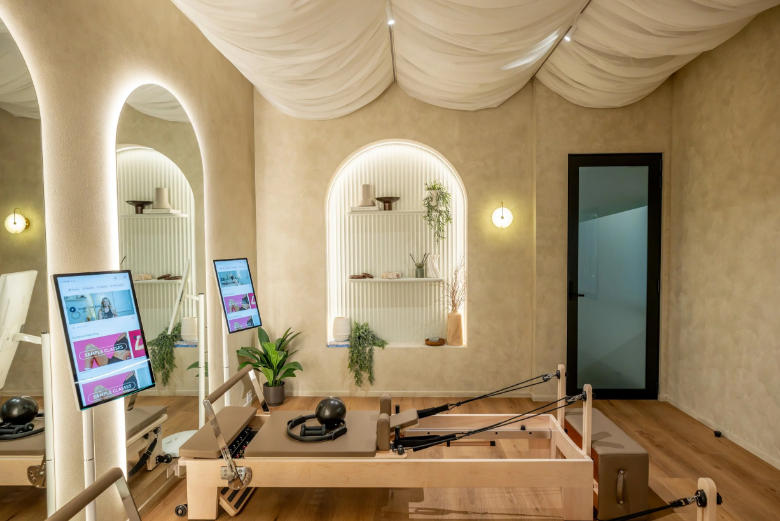
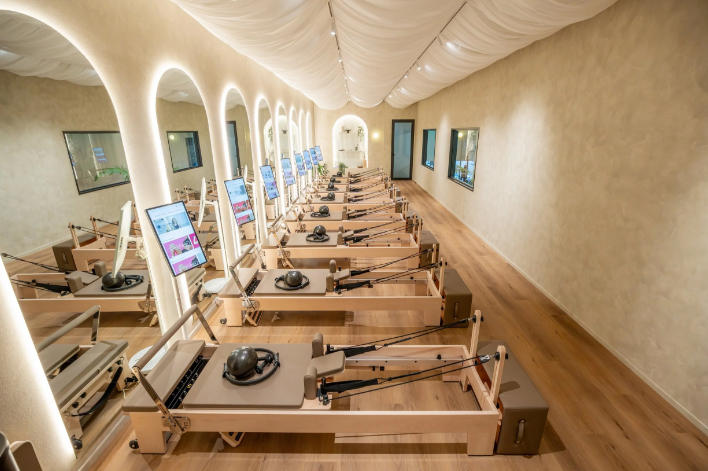
In a room with ten Reformers, the machines create much of the visual pattern. Their frames define the rows, while the upholstery introduces a repeated color across the floor.
Even when the walls and furniture are carefully designed, mismatched equipment can make the room appear less coordinated.
The visual direction also communicates the type of studio being offered.
Natural wood, soft lighting, and warm upholstery may support a calm, intimate atmosphere. Darker frames and stronger contrasts can suit an energetic, contemporary fitness environment.
Neither approach is inherently more professional.
A studio built around neutral tones may appeal to members who enjoy a polished boutique setting, while others may prefer an environment that feels more relaxed and less exclusive.
Branding therefore involves a decision about who the studio wants to welcome, not simply which interior photographs look most fashionable.
The equipment should support that choice. Reformer selection for a quiet private-training studio may therefore differ from the priorities of a busy group-class room. A Reformer that suits a minimalist private-training studio may look out of place in a high-energy group-class environment.
02. Reformers Appear in Member Photos, Instructor Videos, and Studio Tours
Members increasingly encounter Pilates studios through photographs and videos before visiting in person.
In Mindbody's 2025 research into fitness and wellness businesses, 63% of surveyed operators identified Instagram as their most effective client acquisition channel. The survey included more than 1,400 decision-makers across the wider industry, rather than Pilates studios alone.
The figure does not mean Instagram accounts for 63% of bookings. It does show that many operators consider the platform an important part of attracting customers.
For Pilates studios, photographs and videos usually come from three different situations.
After class, members may take mirror selfies, photograph the room, or record short clips with friends. The Reformer often remains visible behind them, even when the equipment is not the subject of the post.
Instructor videos show something different. The machine is central to the frame because the instructor is demonstrating an exercise. Its silhouette, upholstery, and adjustments are visible throughout the movement.
Studio tours and promotional photography show the equipment as part of the whole space. Here, the arrangement of machines, room proportions, lighting, and background become more important than any single product detail.
These situations place different demands on the studio's appearance.
A large logo might be clearly visible in an empty-room photograph but distracting in an instructor demonstration. A finish that looks attractive in a close-up may not create the same effect across twelve machines.
Members sharing their own experiences also provide a form of visibility that differs from official advertising. Their photographs show the studio as they experience it, rather than as it appears in a planned promotional shoot.
This visibility can be valuable, but attractive equipment does not automatically generate bookings. Photography gives people a view of the studio; the classes and service still need to justify their interest.
03. Reformer Upholstery Colors Must Work Beyond Opening-Day Photography
Upholstery has a strong effect on the appearance of a Pilates studio because it covers a large, visible part of each Reformer.
Light beige, cream, and taupe can complement warm interiors. Black and charcoal may create a more restrained appearance, while selected accent colors can reinforce an existing brand palette.
The choice becomes more complicated when cleaning and daily use are considered.
A pale material may show certain marks more clearly. Dark upholstery can reveal dust, powder, or cleaning residue under particular lighting. Neither light nor dark colors are automatically easier to maintain.
A color that looks excellent in the studio's opening photographs needs to remain presentable after months of classes.
Material choice matters as much as the shade. Surface texture, cleaning compatibility, stitching, and resistance to regular wear affect how the upholstery looks over time.
The range of available options can be extensive. Balanced Body's Studio Reformer, for example, offers stock black upholstery alongside 29 custom colors, giving owners considerable flexibility when coordinating equipment with an interior.
More choice, however, can make the decision harder.
A color selected from a website may look different when installed in the studio. Smartphone cameras, window light, overhead lighting, and nearby wall colors can all affect its appearance.
Physical samples are therefore useful, particularly when several machines are being ordered for the same room.
It is also worth considering how the selected material will be cleaned. Harsh or incompatible cleaning products can damage upholstery, regardless of how attractive it looks when new.
Color and maintenance should be evaluated together, rather than treating appearance as a separate purchasing decision.
04. Logo Placement and Matching Equipment Shape Studio Recognition
A logo does not need to dominate a Reformer to be effective.
For some studios, a small mark on the frame or brand plate is enough. Others prefer visible branding that appears consistently across equipment photographs.
The decision depends on how the studio uses its visual identity.
A logo placed on a part of the machine that faces the wall may rarely appear in photographs. One placed near a frequently adjusted mechanism might be visible but inconvenient.
Subtle branding can work particularly well when the studio already has a strong interior design. The equipment supports the overall identity without making every photograph look like an advertisement.
The arrangement of machines also affects how branding is perceived.
When Reformers are photographed together, matching frame finishes and upholstery, along with consistent logo placement, create a more coherent image.
The effect comes from repetition across the room, not necessarily from the prominence of an individual logo.
This becomes more difficult when equipment is purchased over several years.
A studio may begin with six Reformers and add another four after its classes become busier. If the original upholstery or finish is no longer available, the new machines may look noticeably different.
The same problem can arise when a business opens a second location and wants both studios to share a recognizable appearance.
Consistency should therefore be considered before the initial purchase. The availability of finishes, future replacement parts, and additional machines matters to the long-term design of the studio.
05. Pilates Social Media Content Must Respect Members Who Prefer Privacy
Taking photographs after class is different from filming people during a workout.
Many members enjoy sharing their experiences, but others attend Pilates without wanting their bodies or movements recorded.
Even a short promotional video can include people who were not expecting to appear online.
Some members have described how being filmed during a regular Pilates class affects their concentration. The concern is not necessarily opposition to studio marketing; it is having little control over when and how they appear in someone else's content.
This creates a practical distinction between voluntary member sharing and studio-produced promotional material.
A business can encourage photographs after class while limiting recording during instruction.
New Heights Pilates allows members to take photos and short videos before and after sessions, provided they do not disrupt class changes or require additional instructor time. Filming during classes requires prior permission from management, partly to protect other members who may not want to appear online.
This approach gives members opportunities to share their experiences without making filming an expected part of every workout.
Studios can also produce instructor demonstrations outside scheduled classes, photograph empty training rooms, or arrange dedicated filming sessions with participants who have agreed to take part.
The resulting content can still show the equipment, teaching style, and studio atmosphere.
For members, the benefit is a training environment in which cameras are not an unavoidable part of the experience.
06. Equipment Selection Helps Maintain a Consistent Studio Brand as the Business Grows
Visual consistency becomes harder to manage when a studio expands.
The original interior may have been designed around a particular Reformer frame, upholstery color, and room layout. New machines, replacement parts, or additional locations can introduce variations that were not considered at the beginning.
A useful equipment specification therefore covers more than the model name.
It identifies the frame finish, upholstery material, color reference, logo application if required, and any accessories that affect the machine's appearance.
These details help studios compare suppliers and maintain consistency when purchasing additional equipment.
The same considerations apply whether the Reformers come from an established international brand, a local equipment dealer, or a manufacturer offering branded options.
Product photographs are helpful, but they should be supported by accurate material information and, where practical, physical samples.
If a studio plans to use the same appearance across several locations, the long-term availability of its chosen finish becomes particularly relevant.
A supplier may offer a special color for the original order without being able to guarantee it indefinitely. Understanding that limitation early allows the owner to plan future purchases more realistically.
There is also a practical boundary to visual customization.
Changes to upholstery color or a brand plate may be straightforward within an existing product range. Altering the structure or moving functional components is a different decision and should be evaluated according to the machine's intended use.
The best result is a studio where the equipment looks considered without becoming difficult to purchase, maintain, or replace.
Conclusion
Reformer design influences how a Pilates studio looks in person and how it appears in the photographs and videos shared online.
The effect comes from everyday details: equipment that fits the interior, upholstery that remains presentable, branding that feels appropriate, and machines that look consistent across the training room.
Social media makes these details more visible, but it does not change the Reformer's primary purpose.
The equipment still needs to support good teaching and a comfortable training experience.
A strong studio identity develops when the space, equipment, instructors, and member experience belong together. The most effective Reformer design is the one that remains part of that identity long after the opening photographs have been taken.