
How to Find Pilates Reformer Manufacturers for Distribution
To find Pilates Reformer manufacturers for distribution, you can use ChatGPT,Gemini or Perplexity to search for suppliers that match your requirements, look through Google and B2B platforms such as Alibaba, Made-in-China, and 1688, or explore the exhibitor directories of fitness trade shows. Import records, LinkedIn, and industry contacts can also lead you to manufacturers that are harder to find online.
Once you have a few names, contact the companies directly. Find out who produces the equipment, whether they can meet your specifications, and how they support regular distributor orders. Production capacity, wholesale pricing, territory protection, and after-sales service are worth discussing before you commit to a long-term partnership.
1. Are You Looking for a Brand or an OEM Manufacturer?
Before contacting suppliers, it helps to be clear about the kind of distribution business you want to develop.
If you plan to represent an established Pilates brand, begin with the brand's official website. Look for pages titled International Distributors, Dealers, or Become a Distributor.
Some equipment brands publish their existing distribution networks. You can use this information to see whether they already have a partner in your country and contact them about possible cooperation.
Private-label distribution takes a different route.
You may want to buy an existing Reformer model and add your own branding. Or you may have particular requirements for the frame, rail system, Footbar, upholstery, or accessories.
In that case, look for manufacturers offering OEM or ODM services.
A factory that produces standard Reformers may be able to change colors and logos without difficulty. Developing a modified structure requires different capabilities.
Some distributors carry established brands alongside their own product lines. Both arrangements are possible, but the companies you approach and the terms you discuss will be different.
2. Ask AI to Find Manufacturers That Match Your Requirements
AI has become a useful starting point for supplier research.
Rather than searching one product keyword at a time, you can describe your purchasing requirements to ChatGPT, Gemini, or Perplexity and ask for relevant manufacturers.
For example:
Find Pilates Reformer manufacturers in China that supply distributors. I need wooden and aluminum Reformers, OEM branding, possible structural customization, reliable production for repeat orders, and replacement parts. Include official company websites and explain which manufacturing capabilities can be verified from public sources.
You can make the request more specific. Some distributors are looking for particular frame designs or accessories. Others need customized upholstery, branded packaging, or a factory that can accommodate their existing product specifications.
Once AI provides a list, ask it to check the companies individually.
A useful follow-up is to request evidence of manufacturing activity rather than another list of names. The AI can search company websites, exhibitor directories, and other public information.
It may also help identify Chinese company names that differ from the English names used on export websites.
AI is useful for discovering businesses you might otherwise miss. Its recommendations still need checking, especially when a company claims to own a factory or offer particular engineering services.
You should not rely on AI for a manufacturer's current MOQ, production capacity, wholesale prices, or regional distribution policy unless the information comes from a reliable, current source.
Those details are better discussed directly with the company.
3. Search Google and B2B Supplier Platforms
Google remains one of the simplest ways to find Pilates Reformer manufacturers.
The search works better when it reflects the type of business you need. Try Pilates Reformer OEM manufacturer, commercial Pilates Reformer factory, or private label Pilates equipment manufacturer.
Adding a country or a specific product type can narrow the results.
Instead of judging companies by their homepages, open their product and manufacturing pages. Look at the models they produce, their available configurations, and whether their OEM services are explained in enough detail to be useful.
Alibaba and Made-in-China offer another way to build an initial supplier list.
On Alibaba, you can search for Reformers, open company profiles, contact suppliers, or submit an RFQ with your requirements.
Made-in-China provides supplier listings and, for participating businesses, third-party audit reports covering company operations and manufacturing activities. Global Sources is another platform worth checking.
These platforms are convenient because you can contact several suppliers without finding each company's website separately.
However, a supplier badge does not prove that every Reformer in its catalog is manufactured at its own facility.
For buyers who can communicate in Chinese, 1688 is another useful source.
Search terms such as 普拉提核心床厂家 (Pilates Reformer factory), 普拉提器械生产厂家 (Pilates equipment manufacturer), and 普拉提床OEM定制 (OEM Pilates Reformer customization) can reveal businesses that advertise mainly to China's domestic market.
Some of these companies also export. Others may have little experience with international orders, so export packaging, documentation, and overseas support need to be confirmed.
You may also find the same manufacturer on several platforms under different names. Checking the registered company and production address can help you avoid contacting the same business repeatedly.
4. Use Trade Show Directories Before Visiting an Exhibition
Trade shows can be useful even when you do not attend.
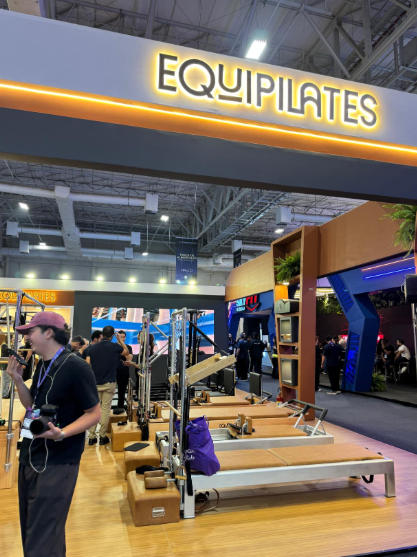
FIBO maintains an online exhibitor directory where buyers can search for Pilates equipment companies. It can lead to manufacturers from different countries, including businesses that are not particularly visible through Google.
For Chinese manufacturers, IWF Shanghai is another place to look. Its exhibitor information includes companies displaying Pilates Reformers and other fitness equipment.
The Canton Fair offers a broader supplier search covering different manufacturing industries.
The best use of these directories is to identify companies before traveling.
You can look through their product ranges, visit their websites, and contact the manufacturers you want to meet. By the time you arrive at the exhibition, you may already have discussed models, prices, and customization requirements.
That makes it easier to spend your time examining equipment rather than collecting catalogs.
Trying a Reformer in person is helpful when comparing carriage movement, adjustment mechanisms, or upholstery finishes.
For distributors considering an OEM project or regular supply, a factory visit may follow the exhibition. It provides an opportunity to discuss production arrangements and see how the equipment is assembled.
An exhibition stand can introduce a manufacturer. The factory visit and subsequent technical discussions help establish what it can actually supply.
5. Look Beyond Search Engines and Supplier Listings
Some manufacturers are easier to discover through their existing business activity than through their websites.
ImportYeti, for example, provides access to information derived from publicly available U.S. ocean freight records.
If you know an equipment importer, you can search its company name and examine the overseas suppliers associated with its shipments. This may reveal businesses that do not advertise extensively on international platforms.
Shipping records have limitations. The listed exporter may be a trading company rather than the actual factory, and not every shipment appears in public data.
LinkedIn offers another route.
After identifying a potential manufacturer, search its company name and look for employees responsible for international sales, OEM development, or business partnerships.
Industry contacts can be useful too. Equipment businesses, purchasing agents, and people met at fitness exhibitions sometimes know manufacturers worth approaching.
Regional business directories, such as Europages, can help buyers looking for European or Turkish suppliers.
These sources often work together. You may discover a company through shipping records, find its website through Google, and reach the export manager on LinkedIn.
6. Check Who Is Actually Manufacturing the Reformers
When searching online, you will encounter factories, trading companies, and brands that use outside manufacturers.
They may all display similar Reformers, sometimes even the same product photographs.
There is nothing inherently wrong with working through a trading company. Some provide useful purchasing, export, and quality-control services.
The important thing is understanding who will actually produce your order.
Before moving into detailed OEM discussions, find out where production takes place, who controls the product specifications, and which company will sign the supply agreement.
A factory may purchase specialized components such as springs, rollers, or upholstery materials. That is normal. What matters is its control over the finished Reformer.
If you are developing a private-label model, ask who will handle structural modifications and approve the final design.
Manufacturing videos, samples, and factory visits can help, although none should be treated as proof on its own.
Trading companies may also arrange visits to partner factories, so a convincing tour is not enough to establish who controls production or who will be accountable for the finished order.
We cover the practical ways to investigate this in our separate article, How to Tell a Real Pilates Reformer Manufacturer from a Trading Company.
7. Discuss Distributor Policies Before Building a Product Line
Our established distributor customers generally plan their purchases ahead of time.
They know their markets and often have clear product specifications and purchasing schedules before regular orders begin.
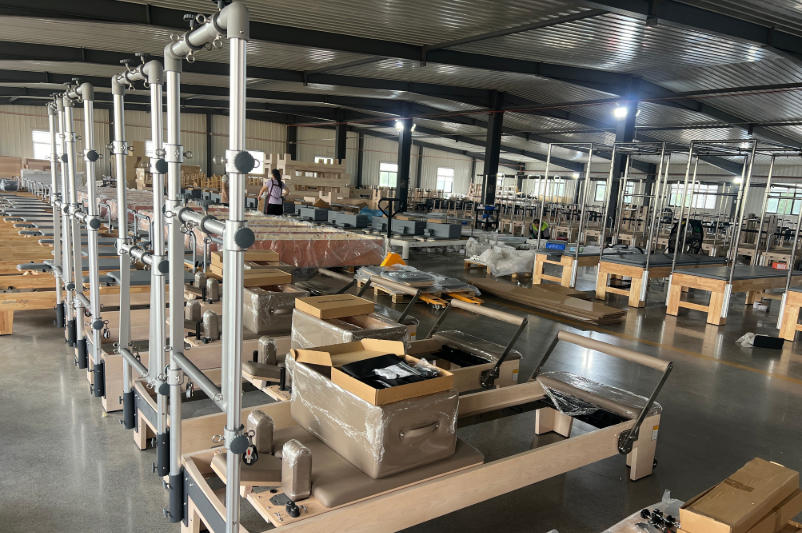
Once models and order arrangements are confirmed, we coordinate production schedules and prioritize agreed distributor orders to help maintain a dependable supply.
That is more useful for an established distributor than relying on a few machines that happen to be available in the warehouse.
Before starting regular cooperation, it is worth discussing expected order quantities, production lead times, and how repeat orders will be arranged. A factory also needs to be realistic about the capacity it can reserve.
Territory protection is another important part of distributor cooperation.
A distributor investing in a particular country or region may want to know whether the manufacturer will appoint additional distributors there or sell directly to customers in the same market.
These arrangements need clear boundaries. The agreement should identify the territory, covered products, and any purchasing commitments or other conditions. Regional exclusivity should not be assumed simply because a manufacturer agrees to supply a distributor.
There is also product-specific protection.
One of our major customers has a dedicated upholstery color code reserved for its Reformers. We do not offer that particular color to other distributors or studio customers.
The restriction is part of our cooperation with that customer. It also means keeping the approved color reference consistent for future orders and making sure the same option is not offered elsewhere.
This is different from territory protection. One concerns where products can be sold under a distribution arrangement; the other concerns a specification reserved for a particular customer.
Wholesale pricing is another subject worth settling early. Distributors may need to discuss volume discounts, minimum quantities, future price adjustments, and support materials for their product range.
Practical shipping requirements can become quite specific as well.
Some of our customers have requirements for the height of the wooden supports beneath their shipping crates. Those dimensions need to be discussed with the customer because they may affect handling at the destination.
We have also received positive feedback about the space inside our wooden crates.
One customer told us that Reformers from another supplier were packed so tightly that the crates had to be dismantled before the machines could be removed. The customer appreciated our more spacious crates because it was easier to take the equipment out.
Compact packaging can reduce freight volume. Easier unpacking also has value, especially for distributors receiving repeated shipments.
After-sales arrangements should be clear before the first order is shipped.
A distributor needs access to compatible replacement parts, technical information, and help with warranty claims.
The factory and distributor should agree on who communicates with the end customer, how faults are assessed, and who is responsible for replacement parts and related shipping costs.
Product consistency matters here too. If a component changes in a later production batch, the factory needs to know which replacement parts fit the machines already sold.
A distributor is building a business around the equipment it purchases. Reliable production, agreed protection policies, and useful technical support make that possible.