
Pilates Equipment OEM vs ODM: Which Manufacturing Model Is Right for Your Business?
Understanding Development Costs, Product Customization, and Long-Term Brand Ownership
When sourcing Pilates equipment from China, choosing between OEM and ODM manufacturing affects much more than how your logo appears on a Reformer. It determines how much control you have over product design, how much you need to invest before production, and how easily you can differentiate your brand from competing suppliers.
For importers and distributors entering the Pilates equipment market, ODM can offer a practical way to launch products without building an engineering team. OEM, on the other hand, provides greater control over product specifications and development, making it attractive to established brands seeking unique equipment.
Neither model is automatically better. The right choice depends on your product requirements, order volume, technical resources, and long-term business strategy.
1. What Do OEM and ODM Mean in Pilates Equipment Manufacturing?
OEM (Original Equipment Manufacturing) generally refers to a manufacturing arrangement in which the buyer provides or controls the product design and technical specifications, while the factory handles production.
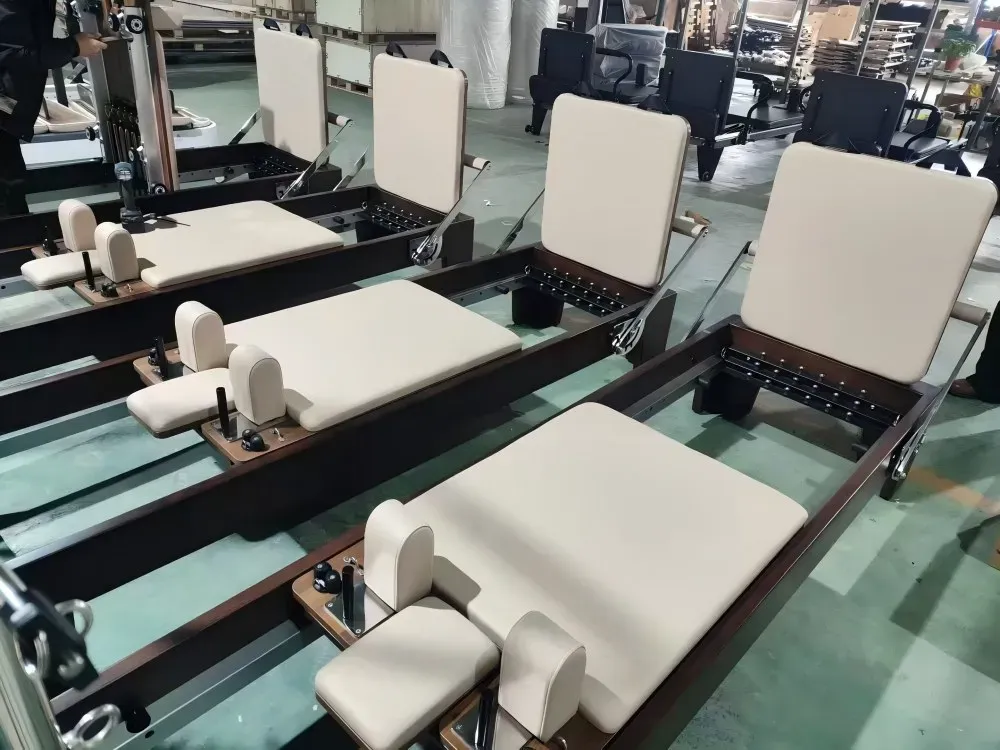
For example, a Pilates brand may develop its own wooden Reformer, specifying the frame dimensions, rail system, spring configuration, and footbar design. The manufacturer produces the equipment according to the approved drawings and specifications.
ODM (Original Design Manufacturing) involves a manufacturer providing an existing product design or developing a product based on the buyer's requirements. The buyer can then sell the equipment under its own brand, sometimes with modifications to materials, colors, components, or configurations.
Consider a distributor selecting an existing aluminum Reformer from a Chinese manufacturer's catalog. The distributor changes the upholstery color, adds a laser-engraved logo, and develops branded packaging. This is more accurately described as private labeling, although many factories include it under their ODM or OEM services.
Factories do not always use OEM, ODM, and private label in the same way. Buyers should therefore clarify which private-label options are already available and which requests require new engineering.
More importantly, design responsibility and intellectual property ownership are separate contractual matters. Paying for product customization does not automatically give the buyer ownership of the original design.
2. OEM vs ODM: Differences in Development Costs, MOQ, and Lead Time
The most immediate difference between OEM and ODM is the amount of development work required before production.
With an existing ODM product, much of the engineering has already been completed. The manufacturer may already have the frame structure, carriage system, production drawings, and component suppliers in place. Buyers can therefore focus on selecting specifications and approving custom finishes.
OEM projects often involve additional engineering work. Depending on the design, expenses may include product development, prototypes, custom tooling, assembly fixtures, component development, and testing.
However, a new mold is not always necessary. Many Pilates Reformers use welded metal structures, machined components, and assembled mechanical systems. A customized frame or footbar may require new engineering and fixtures rather than an entirely new mold.
Minimum order quantities also depend on the type of customization. Changing a logo or upholstery color may require only a small order, while developing a proprietary frame or purchasing non-standard components can increase the MOQ.
Lead times follow the same principle. A standard ODM model can move into production relatively quickly, whereas a new OEM design requires time for engineering reviews, prototype development, revisions, and validation.
For an accurate comparison, ask manufacturers to quote development costs, tooling costs, sample costs, MOQ, and mass-production lead time separately. A single unit price does not reveal the full investment required by either model.
3. Why Pilates Equipment Requires a Different Customization Strategy
Pilates equipment has characteristics that make the distinction between OEM and ODM less straightforward than in many other manufacturing industries.
A Reformer is a relatively large piece of equipment with several mechanical and structural components. Unlike products that require extensive injection molds for multiple sizes or configurations, many Reformer customization projects involve modifying existing manufacturing platforms.
For example, a manufacturer may offer a standard aluminum Reformer but allow buyers to adjust frame dimensions, upholstery, spring combinations, footbar configurations, and leg height.
These changes can create meaningful product differentiation without requiring a completely new design.
This is why many Pilates equipment projects fall between traditional OEM and ODM. The manufacturer provides the basic platform, while the buyer participates in selected engineering modifications. This arrangement is often best understood as customized ODM or hybrid OEM/ODM manufacturing.
The distinction matters commercially. A distributor may not need to finance a completely new Reformer to offer a product that better suits its customers. Adjusting the carriage dimensions, improving an adjustment mechanism, or developing a more practical configuration may provide enough differentiation.
The challenge is determining which modifications add genuine value and which simply increase development costs.
4. Product Quality and Engineering Risks: OEM vs ODM
One advantage of an established ODM platform is its existing production history. If a Reformer has been manufactured repeatedly, the factory may already have experience with assembly tolerances, carriage alignment, spring performance, packaging, and common production defects.
However, an existing product should never be assumed to be reliable simply because it appears in a manufacturer's catalog. Buyers should still examine test reports, sample performance, production records, and customer feedback.
OEM development introduces a different set of risks. A new design may look promising in technical drawings but perform differently once manufactured and assembled.
This is particularly important for Pilates equipment because changes to one component can affect the performance of the entire system.
For example, modifying the spring configuration changes resistance characteristics. Changing the rail or roller system can affect carriage movement. Redesigning a folding mechanism may introduce additional stability and locking requirements.
These changes need to be assessed as a complete system, not only as individual parts. During prototype testing, the factory can check their combined effect before approving the design for repeat production.
A sensible approach is to retain proven components where possible and focus development resources on features that offer measurable customer benefits.
Whether the project uses OEM or ODM, the manufacturer should provide clear material specifications, functional test results, and documented quality controls. The approved sample should also become the reference for subsequent production batches.
OEM does not automatically mean higher quality, just as ODM does not automatically mean standardized quality. Manufacturing capability and engineering validation determine the actual result.
5. Who Owns the Product Design, Tooling, and Intellectual Property?
For a brand planning to grow beyond its first few orders, intellectual property deserves attention from the beginning.
In a typical ODM arrangement, the manufacturer retains ownership or control of its original product design. The buyer receives permission to purchase and sell the equipment under an agreed brand or commercial arrangement.
This can work well for distributors who compete through customer service, marketing, pricing, and sales channels rather than proprietary product engineering.
The situation changes when a buyer invests in a customized design.
Suppose a Pilates brand pays a manufacturer to develop a proprietary footbar structure. Who owns the engineering drawings? Can the manufacturer sell the same design to another customer? Can the buyer transfer production to another factory?
These questions should be answered in the contract, not left to informal promises.
OEM buyers should pay particular attention to ownership of CAD drawings, bills of materials (BOM), custom tooling, and engineering modifications. If the buyer funds dedicated tooling, the agreement should specify ownership, storage, maintenance, access, and transfer arrangements.
ODM buyers seeking market protection should negotiate clearly defined exclusivity. This could cover a particular product configuration, geographical territory, customer segment, or limited exclusivity period.
A confidentiality agreement alone may not provide sufficient protection. Depending on the project, more comprehensive NNN agreements and intellectual property provisions may be appropriate.
The objective is to avoid becoming permanently dependent on one factory simply because the product design and manufacturing documentation remain under its control.
6. Which Manufacturing Model Is Right for Your Business?
The best choice depends on where your business is today and what you are trying to achieve.
For startups and new private-label brands, ODM is generally a practical starting point. Using existing Reformer designs reduces development complexity and allows the business to test pricing, customer demand, and distribution channels before investing heavily in product engineering.
For importers and distributors, ODM offers flexibility when building a product portfolio. A manufacturer with several established models can provide commercial Reformers, home-use equipment, and complementary Pilates products without requiring separate development projects for every SKU.
For established Pilates equipment brands, OEM becomes more attractive when product differentiation is central to the business. If the brand has engineering resources, a clear product strategy, and sufficient demand to justify development costs, controlling the design can create a stronger competitive position.
For Pilates studio chains, the decision is often less about branding and more about operational consistency. Customized ODM can be suitable when the priority is standardizing equipment configurations, maintenance procedures, and replacement components across multiple locations.
There is also a financial question worth considering. OEM development becomes more attractive when the savings or additional profit generated by a proprietary product can recover the initial investment.
A simplified break-even calculation is:
Break-even Quantity = Total Development Investment ÷ Per-Unit Cost Advantage
For example, if development and tooling cost $15,000 and the OEM product saves $30 per unit compared with the equivalent ODM alternative, the break-even volume is 500 units.
This is an illustrative calculation, not an industry benchmark. It assumes comparable product specifications and excludes additional costs such as testing, financing, and inventory risk. If the OEM product offers no unit-cost advantage, its financial justification must instead come from higher selling prices, stronger margins, or other commercial benefits.
7. Can You Combine OEM and ODM to Build a Stronger Brand?
For many growing Pilates equipment businesses, combining both models is more practical than committing exclusively to one.
The process can begin with established ODM products. A distributor selects two or three Reformer models, adds its branding, and tests them through existing sales channels.
After collecting customer feedback and sales data, the business can identify which product deserves further investment. Perhaps the commercial aluminum Reformer sells consistently, while customers repeatedly request a more convenient adjustment mechanism or a different carriage configuration.
Rather than redesigning the entire product, the brand can work with the manufacturer to develop those specific improvements.
Once demand is established, selected models can move toward more extensive OEM development. The brand may invest in proprietary structural features, dedicated components, or unique product configurations.
This approach limits unnecessary development expenses while allowing the product range to become more distinctive over time.
When selecting a manufacturing partner, look beyond its current ODM catalog. Check whether it has an internal engineering team, can modify existing structures, supports prototype development, and can manage testing and mass production within the same manufacturing operation.
A factory that supports both established product platforms and customized engineering can make this transition easier, although independent quality verification remains essential.
8. Choose the Manufacturing Model That Supports Your Long-Term Growth
OEM and ODM serve different business needs. ODM provides access to existing manufacturing expertise and can reduce the complexity of entering the Pilates equipment market. OEM offers greater control over product design and creates opportunities for stronger differentiation, but requires more development investment and technical involvement.
For most new importers and private-label brands, starting with a proven ODM platform is a sensible way to validate the market. As sales grow, selective OEM development can help turn successful products into more distinctive brand assets.
The important decision is not whether OEM is better than ODM. It is knowing which products deserve investment, how much control your business needs, and whether your manufacturing partner can support that strategy.
A good manufacturing relationship should give your business room to grow, not lock it into a product design or supply arrangement that becomes difficult to change.