
Inside Our Pilates Equipment Factory: How Reformers Are Made
The Materials, Craftsmanship, and Precision Behind Every Reformer
A Pilates Reformer may look straightforward: a sturdy frame, a sliding carriage, a few springs, and a set of ropes and pulleys. Yet two machines with similar appearances can feel quite different in use. One carriage glides effortlessly along its rails, while another may produce unwanted friction or noise. The differences often come down to details that are difficult to see once the equipment is assembled.
From hardwood selection and metal fabrication to roller installation and spring testing, manufacturing decisions shape how a Reformer performs. To understand what goes into a well-made machine, it helps to follow its journey through the factory.
1. How Pilates Reformer Production Starts: Design and Material Preparation
Before any cutting begins, engineers work from technical drawings that define the frame dimensions, carriage travel, rail spacing, spring attachment points, and mounting positions for the footbar and other components.
These measurements are closely connected. On a custom Reformer, widening the frame can also mean changing the carriage, rail positions, and connecting hardware. CAD models help identify these conflicts before materials enter production.
Product configuration is also decided at this stage. For example, a Reformer intended for a future Tower upgrade may require factory-drilled mounting holes in the frame. Their positions must match the intended Tower brackets and frame design, so this option needs to be considered before machining and finishing.
Once the design is approved, the factory prepares the required materials. Timber is checked for moisture content, cracks, and warping. Metal profiles are inspected for dimensions, straightness, and surface defects. Springs, bearings, rollers, and fasteners are matched to the specifications for each model.
From here, production takes different routes depending on whether the Reformer has a wooden, carbon-steel, or aluminum frame.
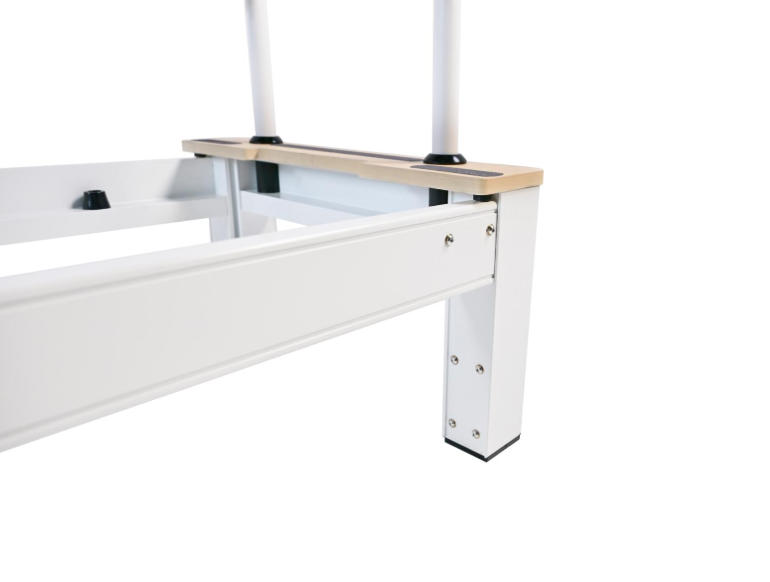
2. Reformer Frame Manufacturing: Wood, Carbon Steel, and Aluminum
Wooden Reformers are often associated with premium Pilates equipment, particularly models made from North American hard maple, also known as rock maple. Its fine grain, hardness, and natural finish make it suitable for exposed structural frames.
In the woodworking area, selected timber is dried, cut, and machined according to the production drawings. CNC routers create the required profiles, mounting holes, and joints before the individual sections are assembled. The frame then goes through sanding and surface finishing.
Wooden frames, however, are not always made from single lengths of solid hardwood.
Finger-jointed timber uses shorter pieces connected through interlocking, adhesive-bonded ends. This approach makes efficient use of selected wood and produces longer structural sections. Laminated timber uses bonded layers, while plywood consists of thin veneers arranged with alternating grain directions to improve dimensional stability.
These constructions involve different production techniques. Finger-jointed timber requires accurate joint machining and bonding; laminated components depend on the preparation, arrangement, and adhesion of their layers.
Material availability also influences manufacturing. In Brazil, for example, some Pilates equipment manufacturers use eucalyptus rather than imported maple. The Arktus Reformer Classic combines solid eucalyptus with internal steel reinforcement, illustrating how wood and metal can be used within the same frame.
Metal Reformers follow a different process, drawing on manufacturing methods already established in the commercial fitness equipment industry.
For carbon-steel frames, tubes are cut to length, drilled, punched, or bent according to the design. Individual sections are positioned in welding jigs, which hold the components in place during welding and help control dimensional consistency.
After welding, the joints are inspected, rough areas are ground smooth, and the frame is prepared for surface treatment. Electrostatic powder coating is commonly used, followed by oven curing to form a protective finish.
Aluminum Reformers have their own manufacturing requirements. Many are constructed from extruded aluminum profiles rather than conventional metal tubes.
During extrusion, heated aluminum is forced through a specially designed die to produce long profiles with a consistent cross-section. These profiles can include hollow chambers, reinforcing ribs, mounting channels, and other structural features.
The extrusions are subsequently cut, drilled, milled, and tapped using CNC equipment. Depending on the frame design, the sections may be joined using bolts, internal connectors, or custom-machined brackets.
Some aluminum Reformer designs incorporate the carriage running surfaces directly into the extruded frame, reducing the need for separate rail components.
Anodizing is a common surface treatment for aluminum. It forms a protective oxide layer on the metal, while powder coating offers an alternative for colored finishes.
For Tower-compatible models, mounting holes are machined at the designated frame positions before final finishing. Factory-prepared holes can simplify a later Tower installation, although the frame and attachment brackets must also be designed to accommodate the additional equipment.
Whether working with hardwood, carbon steel, or aluminum, the factory must maintain accurate dimensions and connection points so the mechanical components can be installed correctly.
3. How Pilates Reformer Carriages and Rails Are Made
The carriage is one of the most demanding parts of a Reformer to assemble accurately. It must carry the user while moving repeatedly along the rails without catching, excessive noise, or noticeable sideways movement.
A typical carriage combines a supporting structure, a padded deck, and rollers fitted underneath. Some designs use plywood for the platform, supported by aluminum or steel components.
Roller arrangements vary considerably. One Italian Reformer design uses eight wheels with sixteen ball bearings. Other models use separate load-bearing wheels and adjustable side rollers, allowing the carriage to be supported vertically while controlling lateral movement.
The rails may be separate components mounted onto the frame or integrated into an aluminum extrusion. In either case, their alignment and spacing must match the carriage assembly.
After installation, technicians move the carriage along the full length of the rails, checking for sticking, unusual friction, and excessive side-to-side play.
If the carriage becomes harder to move at one end, the cause may be an alignment problem rather than a defective wheel. Roller position, rail straightness, and mounting clearances all have to be considered.
A smooth-running carriage depends on how these components fit together, not simply on the number or price of its bearings.
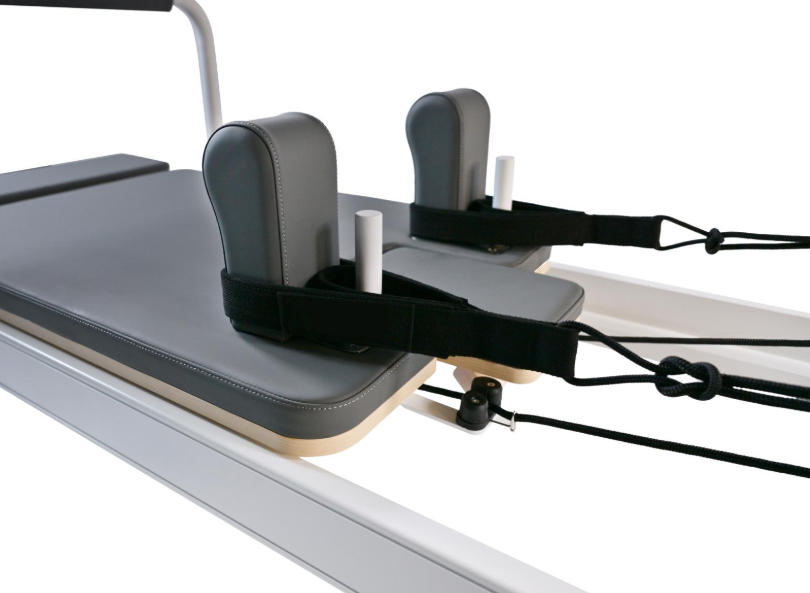
4. Reformer Springs, Pulleys, and Footbar Assembly
Springs provide the adjustable resistance used in Reformer exercises. Their performance depends on the spring steel, wire diameter, coil geometry, and working extension.
Spring manufacturing is generally handled by specialist producers. Steel wire is formed into coils using winding equipment, followed by appropriate heat treatment, end forming, and surface finishing. Some designs use nickel-plated carbon-steel springs for additional surface protection.
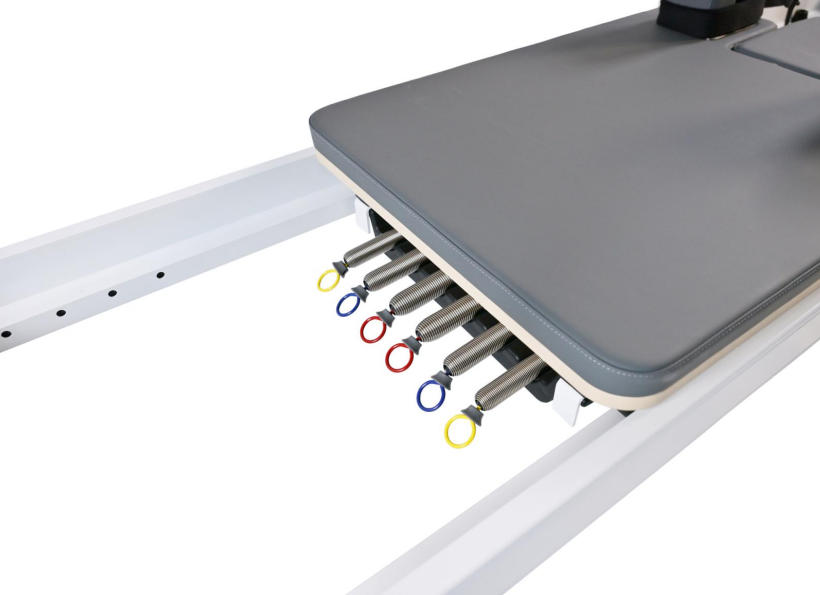
Before installation, springs should be checked against the specified dimensions and resistance characteristics. Color coding helps users identify resistance levels, but the colors are not standardized across manufacturers.
During assembly, the springs are connected to the spring bar and carriage at their designated positions.
Pulley wheels, bearings, brackets, ropes, and handles are installed alongside the springs. Rope routing and effective length require attention, particularly where both sides of the machine need to operate consistently.
The footbar is fitted with its supporting brackets and adjustment mechanism. Each available position is checked to confirm that the locking system engages correctly and remains secure under the intended operating conditions.
5. Pilates Reformer Upholstery: Foam, Sewing, and Finishing
The upholstery workshop handles the carriage padding, headrest, shoulder rests, and other cushioned components.
Material combinations differ between manufacturers. Some use high-density polyurethane foam, while others incorporate EVA or layered padding. One Brazilian Reformer uses two layers of EVA; an Italian design combines neoprene with high-density foam.
Foam is cut to the dimensions of each component before the covering material is prepared. Commercial-grade vinyl and synthetic leather are common choices because they offer different finishes and can withstand regular cleaning.
Another production choice is whether the carriage uses partial or full upholstery. A partially upholstered carriage has padding across the main exercise surface while leaving portions of the wooden or metal platform exposed, often around the outer edges. With full upholstery, the covering extends around the carriage sides, creating a more continuous upholstered appearance.
These two styles require different finishing work. Partial upholstery leaves exposed frame edges that must be properly sanded, coated, or otherwise finished. Full upholstery generally requires more covering material, additional wrapping around the perimeter, and careful corner treatment. Depending on the design, the foam may also extend around the edges.
The covering is measured, cut, and sewn, then fitted over the foam and secured to the supporting structure.
Corners and curved surfaces demand particular attention. Uneven tension can produce wrinkles, while excessive stretching may place unnecessary stress on seams. Workers check the finished surface, stitching, and edges before the component moves to assembly.
For customized studio orders, the upholstery department also handles specified colors, partial or full upholstery configurations, and branded details. Matching material batches helps maintain a consistent appearance across multiple Reformers.
6. Final Assembly: How Reformers Come Together on the Production Line
While frames are being manufactured, other departments prepare the carriages, upholstery, and mechanical components. These separate production streams meet in the final assembly area.
Assembly generally begins with the frame and rail installation. The carriage is fitted and adjusted, followed by the spring bar, resistance springs, footbar, pulley brackets, ropes, and handles. Headrests, shoulder rests, and other accessories are installed according to the model configuration.
Positioning fixtures help maintain consistent component placement during assembly. Technicians also check fasteners, moving parts, and adjustment mechanisms as the machine progresses through the different operations.
Managing this process becomes more complicated when several Reformer models share a production line. Frame dimensions, Tower-ready mounting options, upholstery styles, spring combinations, and accessory packages may differ, making accurate material preparation and assembly instructions essential.
A documented Reformer manufacturing project involved 148 components supplied by 72 companies across six countries. Bringing these components into repeatable production required jig-based assembly and inspections between operations.
Although this represents one particular manufacturing project, it demonstrates the coordination involved in producing Reformers at scale. Components manufactured in different workshops or by different suppliers must ultimately fit and operate as one machine.
7. Pilates Reformer Quality Control: Testing and Preparing for Shipment
Quality control begins before final assembly, with incoming materials, purchased components, and machining operations checked at appropriate stages. These are the kinds of controls buyers should look for when evaluating a manufacturer.
Once a Reformer is fully assembled, inspectors examine both its appearance and mechanical operation.
The carriage is moved through its complete travel range to check for sticking, uneven movement, or unusual noise. Springs and attachment hooks are inspected, while pulleys, ropes, and handles are checked for correct installation.
The footbar is tested at its different adjustment positions, with particular attention to the locking mechanism. Frame connections, exposed edges, upholstery seams, and accessories are also examined. Where Tower mounting holes have been specified, their positions and compatibility with the intended attachment hardware are checked as part of the frame inspection.
Depending on the product specification, additional load, fatigue, or abrasion tests may be performed. These tests require defined conditions, including the applied load, number of cycles, test duration, and acceptance criteria.
After inspection, the machine is cleaned and prepared for shipment.
The carriage is secured to prevent unwanted movement during transportation. Rails, exposed corners, and upholstered surfaces receive protective packaging. Depending on the model, selected components may be removed and packed separately.
The packing team checks springs, handles, ropes, hardware, manuals, and other accessories against the order before sealing the package. Reinforced cartons, foam protection, or wooden crates may be used according to the product dimensions and shipping requirements.
From the first engineering drawing to the final packing check, a Reformer passes through several specialized manufacturing processes. The finished appearance may conceal much of that work, but its effects remain in the way the carriage moves, the frame supports the user, and the resistance system responds during exercise.
What makes a high-quality Pilates Reformer isn't just what you see. It's what goes into making it.